Beyond 35 by 35: Africa Must Shape Its Own Electrification Agenda
By: Benjamin Boakye
African negotiators must move beyond scepticism and ensure that the global electrification agenda connects energy access, clean cooking, mobility and economic transformation.
As negotiations unfold in Antalya, the proposed 35 by 35 global electrification target is encountering hesitation. Some European countries appear reluctant to support the ambition, while African countries have yet to embrace it enthusiastically. Much of the debate reflects the different starting points and development priorities of countries, as well as differing interpretations of what the target should deliver.
For African negotiators, a key concern is how to reconcile the urgent need to expand electricity access with the ambition to increase the productive use of electricity. These should not be treated as competing priorities. Africa needs both, with productive use evolving naturally as access expands. The priority must be to bring electricity to people while creating the conditions for its use to grow from basic household and community needs to commercial activities and, progressively, industrial applications.
At the 2026 Bonn Climate Change Conference, the Turkish COP31 Presidency proposed increasing electricity’s share of final energy consumption globally to 35 per cent by 2035, from just over 20 per cent today. The ambition seeks to accelerate electrification across transport, buildings and industry, largely through renewable energy.
For industrialised economies, this largely means replacing existing fossil fuel technologies with electric alternatives. Africa faces a different challenge. It must extend electricity infrastructure to millions of people who remain unconnected while creating opportunities to electrify existing economic activities.
This difference should inform implementation, not become a reason to dismiss the target.
Access is the foundation of productive use
We must stop treating electricity access and industrial electrification as competing priorities. Bringing electricity to people creates opportunities for productive use. We should not require communities to demonstrate sophisticated economic activities or substantial electricity demand before extending electricity infrastructure to them.
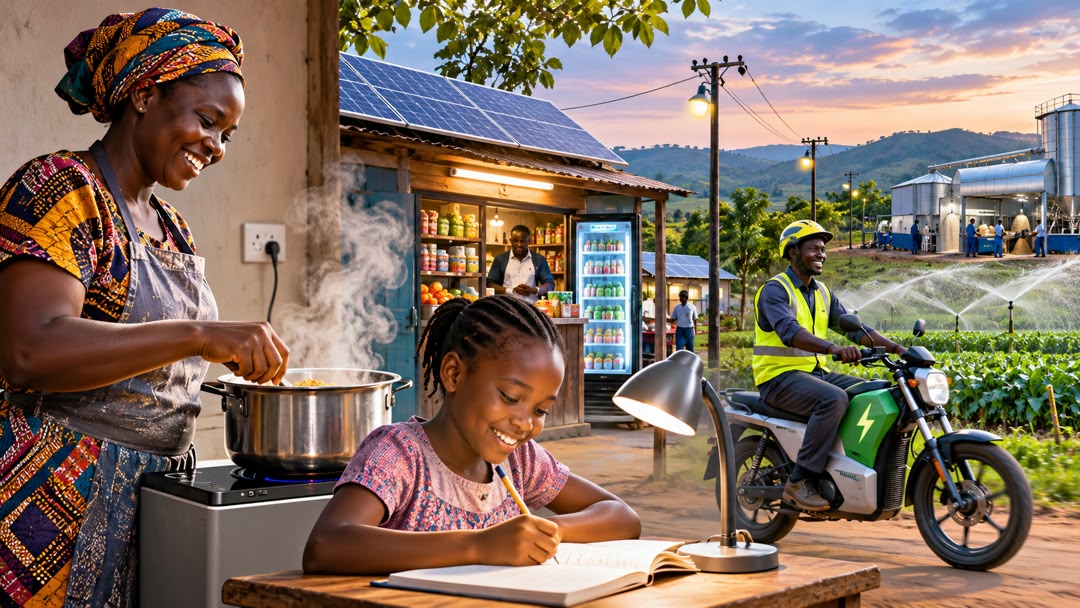
Productive use begins with everyday activities. Electricity enables children to study after dark, households to preserve food, traders to refrigerate their products, small businesses to operate equipment and everyday people to charge their cars, electric bicycles and tricycles.
As access expands and economic activity develops, these uses can grow into more energy intensive applications, including irrigation, agro processing, manufacturing and eventually heavy industry.
This is a natural progression. We should not allow an overly narrow interpretation of productive use, centred on large industrial applications, to undermine the fundamental objective of bringing electricity to people.
Access should not have to wait for industrial demand. Industrial demand should be allowed to grow from access, alongside the development of the economic and technical capacity required to support larger applications.
Do not confuse electricity access with affordability
Another concern in the negotiations is the apparent conflation of electricity access with the ability of communities to afford electricity. These are related but distinct challenges, and they require complementary policy responses.
Electricity access is fundamentally about ensuring that households and communities can connect to an electricity supply. Affordability concerns whether they can consume enough electricity to meet their needs, given tariffs, household incomes and the cost of appliances. A community can gain access to electricity infrastructure even when some households still face difficulties paying for adequate consumption. Indeed, many households in well connected urban areas experience precisely this challenge.
The distinction matters because the two challenges should not be addressed in ways that undermine each other. The inability of a household to afford electricity today should not determine whether its community receives the infrastructure needed to connect. Delaying connections until households can demonstrate an ability to pay risks excluding the very populations whose economic opportunities electricity infrastructure could help improve.
Access can and should be extended while other policy instruments address affordability. These include lifeline tariffs, targeted subsidies for vulnerable households, appropriate financing for connection costs and appliances, and measures that strengthen household incomes. Governments and utilities can also explore payment arrangements that allow consumers to manage expenditure in line with their capacity to pay.
The objective is not to treat affordability as secondary. It is to recognise that infrastructure investment and affordability interventions are complementary parts of the same electrification agenda. One brings electricity within reach; the other helps ensure that households can use it meaningfully. Neither should be made a precondition for the other.
Electrification offers an economic opportunity Africa should seize
The economics of renewable technologies have changed considerably. According to IRENA, the global weighted average cost of electricity from newly commissioned utility scale solar PV fell by 90 per cent between 2010 and 2023. By 2023, it was 56 per cent below the average cost of fossil fuel generation. This strengthens the case for solar as a competitive option for new electricity supply, particularly where conventional infrastructure is expensive to extend.
Many remote communities struggle to access petroleum products. The cost of transporting fuel, limited distribution infrastructure and unreliable supply chains make petroleum expensive and difficult to obtain. Yet these communities often have abundant solar resources.
Locally deployed solar charging infrastructure can provide incentive for electric mobility and addresses the logistical constraints undermining access to energy. Two and three wheeled electric vehicles, and eventually four wheeled vehicles can support mobility where conventional fuel distribution is expensive. Charging stations can also serve markets, agricultural centres and local businesses.
The relevant economic comparison is not simply the cost of grid electricity against petrol or diesel. It is also the cost of transporting and distributing petroleum products against the levelised cost of locally generated solar electricity and battery storage. The opportunities through investments in charging infrastructure, local vehicle assembly, maintenance services and technology adaptation could be more transformative.
Electrification must become part of Africa’s clean cooking solution
Clean cooking deserves particular attention in the 35 by 35 agenda. Sub-Saharan Africa has approximately 970 million people without access to clean cooking, while more than 560 million lack electricity. These are interconnected development challenges.
For too long, clean cooking interventions have concentrated on expanding LPG distribution or promoting improved charcoal and biomass solutions. LPG remains an important transition option, but its expansion requires substantial investment in storage, bottling, transportation and distribution infrastructure. According to the IEA half of sub-Saharan Africa’s LPG demand is imported, illustrating the vulnerability of supply chains.
Meanwhile, dependence on charcoal and fuelwood perpetuates forest degradation and exposes women and children to dangerous household air pollution. The IEA estimates that this contributes to approximately 815,000 premature deaths annually in Africa. Women and girls also spend an average of four hours daily gathering fuel and cooking.
The situation demands that we take the alternative seriously. Communities currently cooking with wood fuels should have the opportunity to transition to electric cooking as electricity access expands. Solar generation, battery storage and appropriate cooking appliances can make this possible in communities.
This is not an argument for abandoning LPG or assuming every household can immediately switch to electric cooking. It is an argument for making electricity a central part of Africa’s clean cooking strategy rather than treating it as a distant possibility and failing to exploit the cost competitiveness of existing technologies.
The challenge is deployment at scale
The technologies required for this transition are increasingly available and economically competitive. The challenge is to mobilise the investment, partnerships and institutional capacity needed to deploy them at scale and adapt them to local conditions. This is a shared responsibility between African governments, development partners, international financial institutions, technology providers and private investors.
African countries must play a leading role by mobilising domestic resources and creating an enabling environment for investment. However, international partners must also help bridge financing gaps through grants, concessional finance, guarantees and technology partnerships. Development finance institutions can help reduce investment risks and crowd in private capital, while local financial institutions develop financing products that enable households and businesses to adopt electric technologies.
The solution also lies in developing business models that aggregate demand across communities, making investments in decentralised energy systems, charging infrastructure and electricity networks commercially viable. Domestic capital pooling, innovative payment arrangements and partnerships with technology providers can accelerate deployment while building local capacity.
The question, therefore, is not simply whether Africa can afford electrification, but how African and international partners can share the responsibility for deploying the most affordable and practical technologies at the speed and scale required.
Antalya must deliver a practical African pathway
African negotiators should use COP31 to establish a clear roadmap for electrification. This should connect grid expansion, decentralised renewable energy, clean cooking, electric mobility and progressively deeper industrial electrification.
Africa must articulate its own bold pathway, identifying the technologies, financing models and institutional arrangements that can accelerate access and electrification. It must then invite credible international support through grants, concessional finance, technology partnerships and investment.
The 35 by 35 target recognises that countries have different starting points and should be able to determine their own electrification pathways. African countries should use this flexibility to shape an agenda that reflects their development priorities.
Africa does not have to wait until everyone has electricity before economic activities begin to develop around it. Neither should communities have to demonstrate sophisticated industrial demand before extending electricity to underserved communities.
We must bring electricity to people and allow productive and industrial uses to evolve as access improves. That is how electricity access becomes an engine of economic opportunity and how electrification can support Africa’s structural transformation.
The 35 by 35 agenda must become more than a global climate ambition. For Africa, it must be a pathway to universal access, clean cooking, productive economies and industrial transformation.