Ghana’s Resource Nationalism Debate: Why Clarity From Government Matters Now
By: Benjamin Boakye
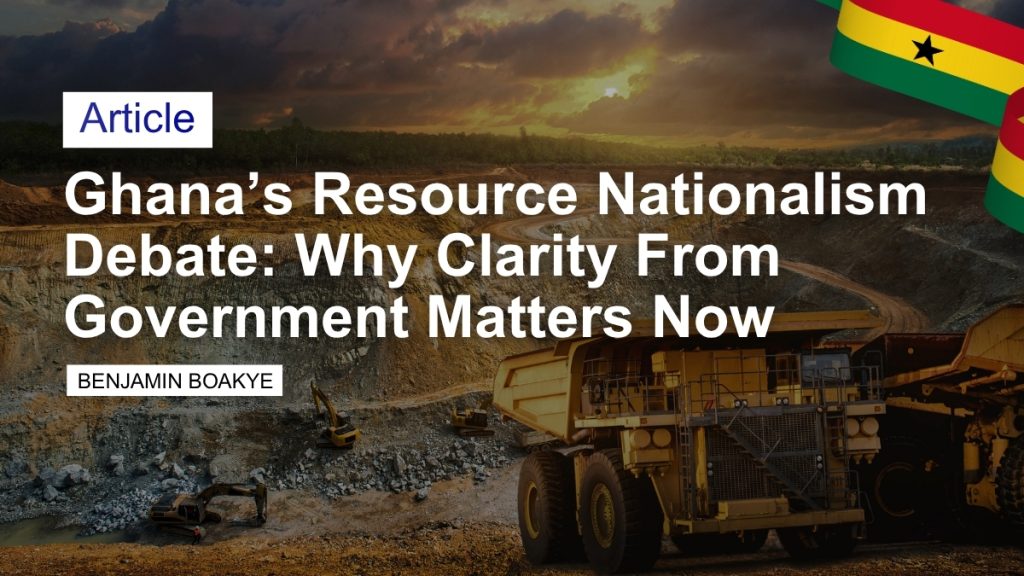
Ghana is once again at a critical policy crossroads. A renewed national conversation around resource nationalism, particularly in the mining sector, is gathering momentum, driven by growing public concerns over whether the country is receiving adequate value from its vast mineral wealth. The debate has intensified further because of the stature and influence of some of the personalities advocating more aggressive state intervention, including calls for mine nationalization and restrictions on lease renewals.
At a time when Ghana has just concluded its IMF-supported programme and is now seeking a Policy Coordination Instrument (PCI) with the IMF to anchor macroeconomic discipline, policy credibility, and investor confidence, silence or ambiguity on such a consequential issue may create avoidable uncertainty within the investment community. The government must therefore urgently and clearly state its position on the direction of Ghana’s mining policy and the broader question of resource nationalism.
This is not merely a sectoral discussion. It is a defining economic moment. The mining industry remains one of Ghana’s most important sources of foreign exchange, fiscal revenues, employment, and long-term capital inflows. Any signals suggesting abrupt policy reversals or heightened sovereign risk will inevitably affect investor perceptions at a time when Ghana is working to consolidate macroeconomic stability, reduce country risk, attract lower cost of capital, and position itself on a sustainable growth trajectory.
At the heart of the current debate is a legitimate and reasonable question: Is Ghana obtaining sufficient value from its mineral resources?
That question should not be dismissed. Every fiscal regime, regulatory framework, and extractive arrangement must be periodically reviewed to assess whether the state is maximizing national benefit while maintaining competitiveness. No mining regime should be treated as permanently optimal. Economic conditions evolve, commodity prices change, technologies improve, and national development priorities shift. It is therefore entirely appropriate for citizens and policymakers to interrogate the structure of benefits accruing to the state.
However, any serious national conversation on mining policy must be anchored in data, facts, and a fair understanding of how modern mining economies operate. There is little value in purely sentimental debate.
One of the more extreme proposals emerging from the public discourse is the call for nationalization of mines, largely premised on the argument that several mining leases are approaching expiration and therefore provide an opportunity for the state to take over these assets. This interpretation, however, misunderstands both the intent of Ghana’s mining laws and the commercial realities of the industry.
It also ignores Ghana’s own historical experience. Ghana experimented with extensive state control and nationalization of the mining sector in the 1970s. The outcome was not the strengthening of the industry, but rather a significant decline in production, underinvestment, operational inefficiencies, and eventual collapse of large segments of the sector. The country ultimately had to reverse course and reopen the industry to foreign direct investment and private capital under the economic reforms of the 1980s and 1990s.
That historical lesson remains important today. Mining is one of the most capital-intensive and technically demanding industries in the world. Sustaining production requires continuous investment in exploration, reserve replacement, equipment modernization, environmental management, and operational efficiency. Without sustained access to long-term capital and technical expertise, mining industries deteriorate rapidly.
This reality explains why the framers of Ghana’s mining legislation, consistent with practice in many mature mining jurisdictions, were deliberate in designing lease renewal systems that provide continuity and predictability. Mining leases were never intended to operate as simple short-term concessions that automatically terminate at the end of their initial periods regardless of performance.
Rather, the law envisages renewal unless there are material breaches of lease obligations. In many cases, even where breaches occur, remedies short of outright cancellation are available. This is because the overriding objective is to sustain long-term investment, reserve development, production continuity, employment, and fiscal contribution to the state.
The framers of the law understood that mining companies nearing uncertain lease expirations would naturally reduce long-term investments and shift into “exit mode,” undermining production and national economic interest. Predictability was therefore intentionally built into the system to encourage continuous capital deployment. It is therefore inaccurate to interpret lease renewal periods as automatic opportunities for expropriation or arbitrary state takeover.
This does not mean the state is powerless during renewals. Far from it. Lease renewals provide government with legitimate opportunities to reassess fiscal terms, local participation obligations, environmental commitments, infrastructure contributions, and broader developmental outcomes within the limits of the law and through good-faith negotiations. The state can negotiate improved terms where materially justified. But such adjustments must be evidence-based, commercially realistic, and mindful of global competitiveness.
Importantly, lease renewal does not imply automatic fiscal stagnation. Governments retain the ability to revise fiscal frameworks in line with prevailing legal and economic conditions. What investors seek is not immunity from change, but predictability, fairness, and rule-based governance.
The importance of stable renewal frameworks becomes even more critical in Ghana’s emerging era of indigenous participation in large-scale mining. Increasingly, local Ghanaian firms are entering segments of the mining industry once dominated entirely by multinational corporations. This is a positive development that should be encouraged. However, domestic mining firms are particularly vulnerable to politicization, especially within highly polarized political environments where businesses are often microscopically scrutinized through partisan lenses.
Stable lease renewal systems help shield local firms from excessive political uncertainty and create the conditions necessary for organic growth and long-term capital formation. Conversely, proposals to fundamentally alter mining lease structures, such as limiting operations to rigid 10-to-15-year non-renewable arrangements, could significantly increase financing costs for both foreign and domestic firms. Mining financiers price political and regulatory uncertainty aggressively. If investors perceive heightened risks around asset continuity, companies will struggle to attract affordable long-term capital.
The implications extend beyond private investors. Higher financing costs mean greater portions of mining revenues are diverted into debt servicing and interest payments rather than taxes, royalties, dividends, local procurement, and employment. Ironically, policies intended to increase national benefit could ultimately reduce the state’s overall fiscal take.
This is why serious mining jurisdictions carefully balance national interest with investment stability. Countries that have succeeded in maximizing mineral wealth have generally done so through policy consistency, competitive fiscal regimes, institutional strength, and strategic negotiations, not abrupt nationalization rhetoric. Ghana must therefore approach the current debate with caution, maturity, and strategic clarity.
There is room for reform. There is room for stronger local participation. There is room for improved fiscal optimization. There is room for enhanced value retention within the economy. But there is little room for policy unpredictability at a time when the country is seeking to consolidate macroeconomic recovery, deepen investor confidence under a potential IMF PCI framework, and lower sovereign risk.
The government’s position on resource nationalism can no longer remain implied or assumed. It must be explicitly articulated. Markets, investors, domestic businesses, and citizens need clarity on whether Ghana intends to preserve the core principles of contractual sanctity, regulatory predictability, and investment stability that have historically underpinned the mining sector.
The debate itself is healthy. But the outcome must strengthen Ghana’s competitiveness rather than weaken it. At this moment in Ghana’s economic recovery, credibility may prove to be one of the country’s most valuable national assets.
Signed.
Benjamin Boakye
Executive Director