When Policy Credibility Is Tested: Gold, the Cedi, and the Cost of Short Term Wins
By: Benjamin Boakye
The credibility of economic policy is ultimately tested by its sustainability, not by a fleeting moment of excitement. In Ghana’s current macroeconomic context, this distinction is becoming increasingly important.
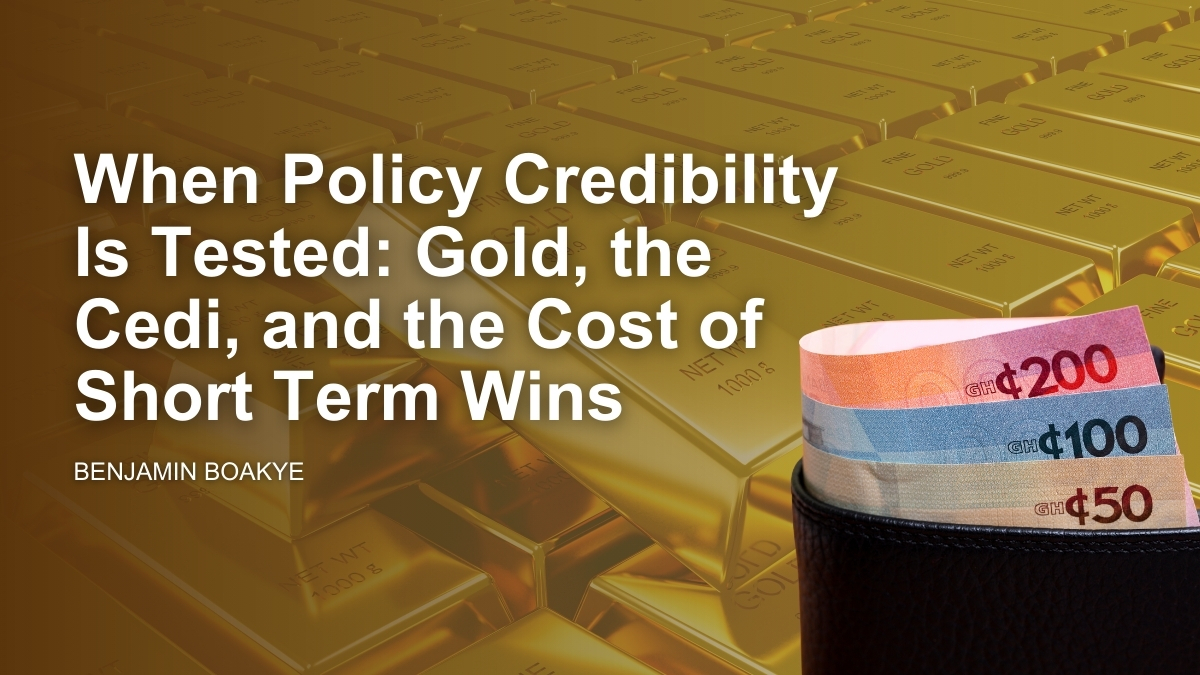
The performance of the cedi has been unprecedented in recent history and has generated widespread public enthusiasm. For government, this represents a significant political boost in a country where exchange rate movements has implications for the performance of the government and often influence electoral outcomes. Within this environment, it has become difficult to interrogate the policy choices underpinning the stability, and the treatment of the IMF reported US$214 million loss incurred by the Bank of Ghana and by extension the country.
There is now a growing tendency to attribute the cedi’s performance almost entirely to the central bank’s gold purchase programme. This narrow framing discounts several other material factors that have supported currency stability. Record high global gold prices, rising gold output, and incremental improvements in fiscal governance have all played important role. By collapsing these diverse influences into a single policy narrative, the analysis exaggerates the effectiveness of the gold purchase programme while understating the contribution of broader economic and structural developments. This over attribution weakens objective assessment and risks entrenching policy choices that may not be responsible for the outcomes being celebrated.
Commodity Booms Require Caution, Not Complacency
It is in the interest of government to tread carefully during commodity boom cycles. Ghana has lived through the consequences of policy complacency before, and the NDC should know better. During the 2014 to 2015 downturn, when both oil and gold prices performed poorly, the country suffered severe fiscal stress. In 2014 alone, revenue shortfalls from oil was about one billion dollars. In the same year gold price declined to about $1200 from the 2011 peak of $1900. Today, the cycle has reversed. Gold prices are strong and production is rising. That reversal, however, demands caution rather than confidence.
Gold production itself was projected to rise materially in 2025, supported by the addition of new large scale capacity. The most significant contribution come from the Namdini mine developed by Cardinal Resources, which achieved first gold in late 2024 and was expected to ramp up through 2025. Output from Namdini alone is projected to add approximately two hundred and fifty thousand to three hundred thousand ounces of gold for 2025, even before reaching steady state production. Newmont also brought on stream its Ahafo North project in the last Quarter of 2025. This incremental output materially strengthens export receipts and foreign exchange inflows independently of any central bank gold purchasing activity.
If losses are being incurred during a boom cycle, the implications during a bust cycle will be far more severe.
There is nothing inherently wrong with the state choosing to play a more active role in gold trading. The concern arises when such involvement leads to booked losses and crowds out more effective policy options required to optimise the country’s gold resources without booking losses.
Gold Production Economics and the Circulation of Foreign Exchange
Gold production economics are straightforward. Gross revenues are allocated to capital and operating costs, taxes and royalties, and profits. Operating costs alone typically account for between 60-75% of total revenues. These costs must be financed continuously for production to be sustained. If revenues from gold do not circulate back into the domestic economy, future production itself is placed at risk.
Recent central bank interventions appear to be anchored on a flawed assumption that Ghana loses gold value simply because proceeds do not return through the Bank of Ghana. Historically, a significant share of foreign exchange from the mining sector returned through commercial banks. These inflows helped to moderate pressure on central bank reserves and supported overall market liquidity.
By monopolising a major source of foreign exchange inflows, the central bank has effectively deprived commercial banks of direct flows from the gold sector. As a consequence, the Bank of Ghana has had to inject billions of dollars into the market to stabilise the currency, creating a self reinforcing policy loop. This is creating significant arbitrage between central bank rates and rates traders source dollars on the market on account of multi-staged FX pricing, instead of direct flows to the commercial banks.
The Small Scale Gold Dilemma
A more troubling consequence of the current approach is the monopolisation of small scale gold through price premiums rather than through effective regulation. The central bank buys doré gold at international market price when the practice is to buy at a discount to account for refining losses and operational expense. This has extended financial incentives to a sector characterised by widespread illegality, including unlicensed operations, tax and royalty evasion, and general non compliance by licensed operators.
In practice, it is difficult to identify small scale gold sources that fully comply with existing laws, both on account of environmental governance and fiscal compliance. Paying premiums to such a sector is not policy innovation. It is a fiscal and governance failure.
The fiscal implications are significant. In 2024, Ghana generated approximately GHS 18 billion from the mining sector. 98% of this revenue came from large scale mines, despite the fact that these mines account for only about 45% of total gold output. In 2025, the Bank of Ghana reportedly purchased around $11 billion worth of gold from the small scale sector.
Had Ghana applied even the minimum fiscal take required by law, royalties alone would have generated roughly $330 million dollars from small scale gold. If taxation levels were even half of those applied to large scale mining, total fiscal take could have been about $800 million, accounting for the state’s ownership of the resource. Instead, the country forfeit’s these revenues and additionally absorbed a $214 million trading loss.
Smuggling Is a Governance Failure, Not a Pricing Problem
The justification advanced for buying gold at a premium is that it curbs smuggling. This argument exposes a deeper policy failure. Smuggling is not driven by insufficient incentives but by weak enforcement and official complicity.
Investigations by ACEP and JoyNews have demonstrated how gold exits Ghana through the airport with the involvement of state officials. Smuggling networks are not hidden from actors within the sector. Crucially, producers themselves are rarely the smugglers.
The appropriate response to smuggling is regulatory enforcement, not financial compensation to the illegal operations.
Smugglers respond to economic incentives, and cross border patterns shift according to relative policy regimes. ACEP’s work shows how artisanal and small scale gold has historically flowed towards jurisdictions with lower export charges across the subregion because of weak enforcement. By offering premiums, Ghana has positioned itself as the most attractive destination in the sub region.
This creates a dangerous outcome. Rather than eliminating smuggling, Ghana risks becoming a regional hub where gold from neighbouring countries is sold locally, premiums are paid in cedis, converted into foreign exchange, and illegally repatriated. In effect, a gold smuggling problem is transformed into a foreign exchange smuggling problem, increasing pressure on the currency and compounding losses on the central bank’s balance sheet. If left unchecked, the macroeconomic consequences will be severe in the near term.
Conclusion
The state has effectively lost control over the fiscal benefits of the small scale gold sector. This outcome is not accidental but reflects persistent weaknesses in enforcement and, in some cases, the complicity of state institutions. This failure represents a fundamental policy concern that must be addressed decisively. Restoring control requires the application of credible punitive sanctions that compel compliance, reaffirm the supremacy of the law, and protect the state’s right, as resource owner, to its lawful share of gold revenues.
In 2025, gold revenues from the mining sector are projected to exceed twenty billion Ghana cedis, driven by increased output from large and small scale producers. Yet, at the same time, the central bank and GoldBod are rewarding this illegality with premiums to the segment responsible for the largest share of gold output, the small scale sector, without securing corresponding fiscal returns.
An urgent policy reversal is therefore required. This must be anchored in credible oversight, strict enforcement of existing laws, and an unambiguous commitment to securing the state’s rightful share of mineral rents.
It is important to note that if the state passes a law designating GoldBod as the sole purchaser of gold, only to argue that the law cannot be enforced without paying premiums to producers, then the law itself is rendered meaningless. A legal framework that relies on financial inducements rather than enforcement to secure compliance undermines the authority of the state and calls into question the seriousness of the policy from the outset.
Policy Recommendations
To restore policy credibility and ensure long term sustainability, a number of actions are required.
First, government must undertake a comprehensive review of the policy enforcement regime to hold institutions accountable for the non enforcement of existing laws. This should include mandatory disclosure of gold output by small scale miners, supported by credible monitoring systems and clear, punitive consequences for failure to disclose production accurately.
Second, payment of fiscal obligations must be the primary condition for the retention of a mining licence. Legality does not reside merely in the acquisition of an operating licence but in continuous compliance with the laws and conditions attached to that licence. Small scale operators should not be permitted to maintain ownership of mineral rights without meeting their statutory obligations to the state. It is unacceptable for licence holders to retain mining rights while failing to pay royalties, taxes, or other legally mandated charges. The fiscal benefit of mining lies in state ownership of the resource, not in the trading of the commodity.
Third, GoldBod must be adequately resourced and provided with clear legal authority to operate under a coherent commercial and regulatory strategy that advances the national interest. The continued use of price premiums to attract small scale gold should be discontinued, as this approach entrenches tax avoidance, environmental degradation, and illegal mining practices, while simultaneously deepening trading losses on the Bank of Ghana’s balance sheet. In this effort GoldBod could be task and incentivized to police the overall fiscal take of the state from the small scale gold sector in addition to its commercial role.
Finally, while it is appropriate for the Bank of Ghana to hold gold as part of its reserve portfolio, the central bank must recognise that a country endowed with substantial in situ gold reserves and annual production exceeding four million ounces, monetary policy interventions should instead support export diversification beyond volatile commodity dependence, thereby strengthening the resilience and long term stability of the domestic currency.